

Discerning the Body
The Eucharist and the Estranged Brother

A note from Phil
As we began our slow trod through topics of debate and division within the church, Graham Monroe reached out to me asking to write a piece on the Eucharist. I was excited for two reasons:
First, I am fairly ignorant on the historical and nuanced arguments around the topic, and so am grateful for someone far more versed than me to step in (and to educate me along the way). And second, Graham is a brilliant writer and critical thinker. If you aren’t following his current writing adventure, you should. Consider this not only an excellent introduction to the topic of the Eucharist, but to Graham as well.
I write as a layperson.
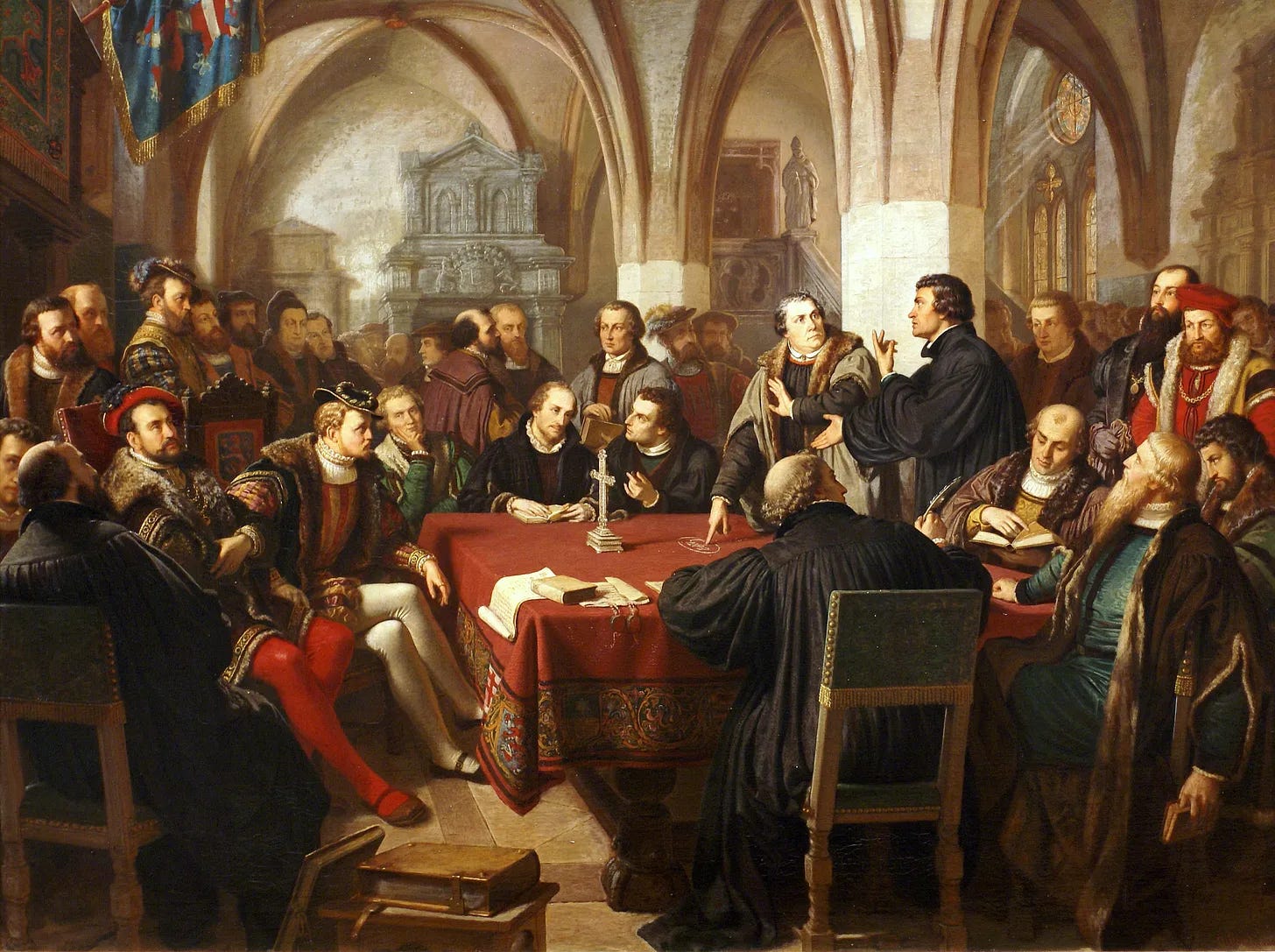
October of 1529, Marburg, Germany.
A time of fresh and dangerous ideas. Conflicts wracked the tumultuous world of Renaissance Europe, now aggravated by the throes of the Reformation.
Philip I, Landgrave of Hess, had summoned the principal reformers, Swiss and German, to his castle in hopes of solidifying a Protestant political alliance. Among those assembled were men whose names would echo down through the ages: Zwingli, Melanchthon, Bucer, Luther.
Fourteen articles of the faith, drafted and unanimously accepted by the disputing theologians, demonstrate substantive unity in such essential theological tenets as the doctrine of the Trinity, the divinity of Christ, and justification by faith. Only the fifteenth article—the one concerning the Eucharist, the sacrament of the broken body of Christ—proved irreconcilable.
“And although we have not been able to agree at this time,” the joint statement concludes, “whether the true body and blood of Christ are corporally present in the bread and wine [of communion], each party should display towards the other Christian love, as far as each respective conscience allows, and both should persistently ask God the Almighty for guidance so that through his Spirit he might bring us to a proper understanding. Amen.”
Though it reads charitably enough, the statement belied a contentious reality.
Early on in the debate, Luther had written the Latin words of institution hoc est corpus meum, “this is my body” (Matthew 26:26, Mark 14:22, Luke 22:19, 1 Corinthians 11:24), on the table with chalk, and covered them with a velvet table-cloth.
The debate ranged back and forth. Luther couldn’t abide Zwingli’s memorialist view of the Eucharist; to Luther, it was a simple matter of adherence to Christ’s words. For Zwingli, the Lutheran argument of the ubiquity of Christ’s body seemed nonsensical, falling short of the simplicity the Lutherans claimed. The Reformed side argued the spiritual nature of communion from John 6:63. Both objected to the Roman Catholic doctrine of transubstantiation.
For his part, Luther refused to acknowledge the Swiss as genuine believers. “Today the Landgrave is making every effort to unite us,” he wrote to his wife, “or at least to make us consider each other brethren and members of Christ’s body. He is doing his best to accomplish this. But although we object to be brethren, we wish to live at peace and on good terms… I consider God has blinded them, that they cannot achieve anything good.” [Emphasis added]
At a climactic moment, Luther withdrew the tablecloth and pointed to the objective words of Christ: this is my body. For Luther, it wasn’t a matter for compromise.
Andreas Osiander, a Lutheran chronicler, gives Luther’s words to his still unconvinced opponents as follows: “Our spirit does not harmonize with your spirit. Rather it is clear that we do not have the same spirit, for it cannot be the same spirit when in one place the Word of Christ is simply believed and in the other the same faith is ridiculed, disputed, denigrated, and attacked with any number of sacrilegious and blasphemous words.” [Emphasis added]
The argument ended in bitter division. “We should let you leave and commend you to the just judgment of God. He will know well, who is right,” Luther concluded. Johannes Oecolampadius, speaking for the Reformed contingent, replied likewise. “As we leave you.” Osiander, the chronicler, notes that Zwingli was teary-eyed.
Osiander also records the Reformed group’s request for mutual communion. “They unfairly damned and bad-mouthed us, calling us cannibals, Capernaites, [and] Thyesteans,” he writes, “and [made] other slanderous claims that we worship a God of bread, a baked God, a gluttonous and drunken God. And yet they asked us to accept them as brothers!”
No such fellowship was granted.
In private remarks to his own side, Zwingli poured out his disdain for Luther. “These and other innumerable vacillating, absurd, and foolish utterances of his, which poured forth tirelessly from him like water rippling on a beach, were refuted by us so successfully that the Prince himself is now on our side; although publicly, in the presence of certain princes, he pretended not to be. Almost the entire Court of Hesse has deserted Luther… Truth prevailed so clearly that if anyone was ever beaten, it was the impudent and obstinate Luther, who was beaten publicly, albeit only in the eyes of clear-sighted and just judges; may he scream as loudly as he wants that he remains unbeaten, etc.” [Emphasis added]
The damage had been done. Both sides would harden into mutually exclusive confessions concerning the Eucharist.1 2
Five hundred years later, the wounds remain unclosed.
As the splintered remnants of the Landgrave’s political dream filtered out to go their separate ways, I wonder if Luther met Zwingli’s teary eyes one last time. Triumphantly? Regretfully?—I wonder if he, too, felt an uncommunicated pang at the parting—if history might have gone differently, had he only expressed a desire for fellowship rather than satisfaction or arrogance (as Zwingli and his fellows certainly perceived, whether actual or not) at the blindness which Luther supposed belonged to his dissenters. I wonder if fellowship might have been maintained, had he been an Ananias willing to find a brother in his persecutor Saul (Acts 9:17).3
Reader, who is not spiritually blind in some degree on this side of eternity? Do we not in our incompleteness still persecute one another continually, even as we profess Christ? Isn’t that why we depend on grace?
Was it Luther’s own unjust treatment by the ecclesial authorities that scarred him into making of himself an island?
As he watched the ones he wouldn’t recognize as brethren shuffle out the door, I wonder if those abandoned words, scrawled in chalk on the table of dispute, still echoed in Luther’s mind. This is my body…
Theology Is Dangerous
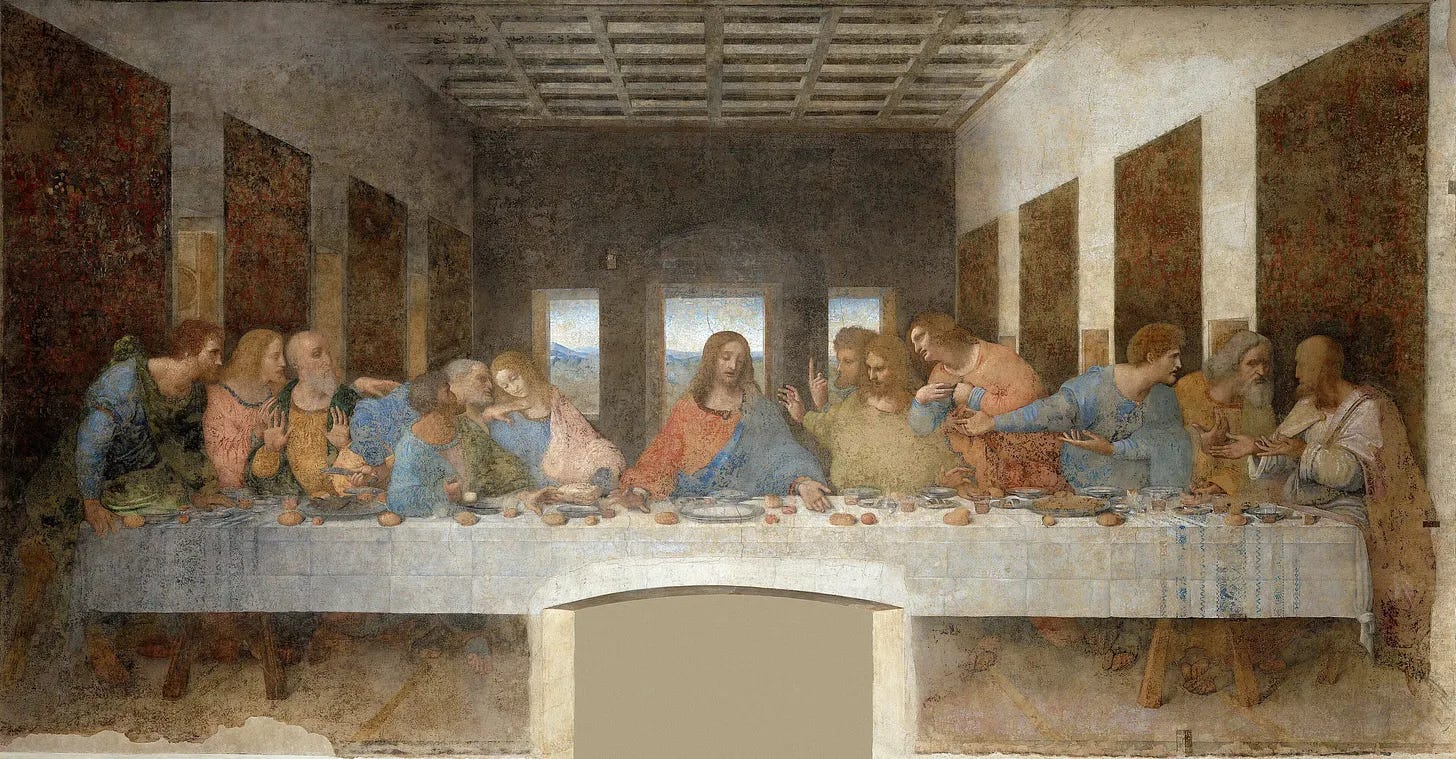
The Eucharist is a thorny dispute. Allow me to briefly touch on the arguments, to illustrate why.
“Truly, truly, I say to you, whoever receives the one I send receives me, and whoever receives me receives the one who sent me.” — John 13:20
What is the Eucharist?
From the time of Justin Martyr onward, the faithful have acknowledged Christ’s presence in the meal which He instituted. But how is He present?
Some confess Him to be bodily present in the bread, with the bread, under the bread. Some confess that the bread is substantially transformed. Some are content (or sufficiently confused) to relegate it to mystery. Some believe in a spiritual presence. Some say that we are lifted up to heaven in partaking. Some view rather that Christ descends to us. For all, it is a participation (1 Corinthians 10:14-22). For some, it is held to be a sacrifice. A re-presentation. A liturgical recollection. A time of remembrance. A proclamation. An offering of praise.
The reformers themselves variously concurred on the necessity of faith for rightly partaking. “To eat the body of Christ spiritually is equivalent to trusting with heart and soul upon the mercy and goodness of God through Christ,” Zwingli wrote. “That person is truly worthy and well prepared [to partake],” Luther taught, “who has faith in these words: ‘Given and shed for you for the forgiveness of sins.’” Calvin, speaking of the Sacrament, explained, “Christ offers himself to us with all his benefits, and we receive him by faith.” But conflicting views of the elements are difficult to reconcile.
Suppose, for the sake of argument, we consider that it is Christ Himself, within the elements. Should He not be adored?—how abominable, to fail to recognize His presence! How could you call yourself a follower of Jesus and give him the cold shoulder, if you bumped into him in the middle of a crowd? Could you stand before your Judge and defend your failure to confess Him, just because it was publicly awkward?
Now suppose, likewise, that we take a more spiritualized view. What was compulsory now looks frighteningly akin to idolatry—the worship of bread and wine, material stuff. Superstition. Dependence on works. Maybe the stilted ceremony seems invested with exactly the kind of self-righteous hypocritical scrupulosity for which Jesus castigated the Pharisees. Or shall I name as my Savior that which is not capable of speech?
But it gets thornier.
You see, the arguments about the presence of Christ branch off into soteriology—the doctrine of salvation. The nature of the Gospel. Was His sacrifice really once for all (Hebrews 9:24-26)? Is not His complete righteousness imputed by faith (Romans 4:3)? Do we receive grace by partaking? Spiritually? Bodily? Haven’t we already received the grace? What is grace, anyway?
If you further hold that valid consecration of the Eucharist is dependent on the valid ordination of the celebrant, you find yourself confronted with a barrage of confusions regarding disputes of apostolic succession. Who gets to be the church?
If that’s not intimidating enough, it gets thornier still.
Suddenly we find ourselves in the realm of theology proper—Trinitarian theology, the stuff that really divides Christians from heretics.4 Where, precisely, is Christ? What is the relationship between His two natures—between the attributes of the divine nature, and the human?
Reader, heed the words of the Psalmist.
“O LORD, my heart is not lifted up;
my eyes are not raised too high;
I do not occupy myself with things
too great and too marvelous for me.” — Psalm 131:1
I Hear That There Are Divisions Among You
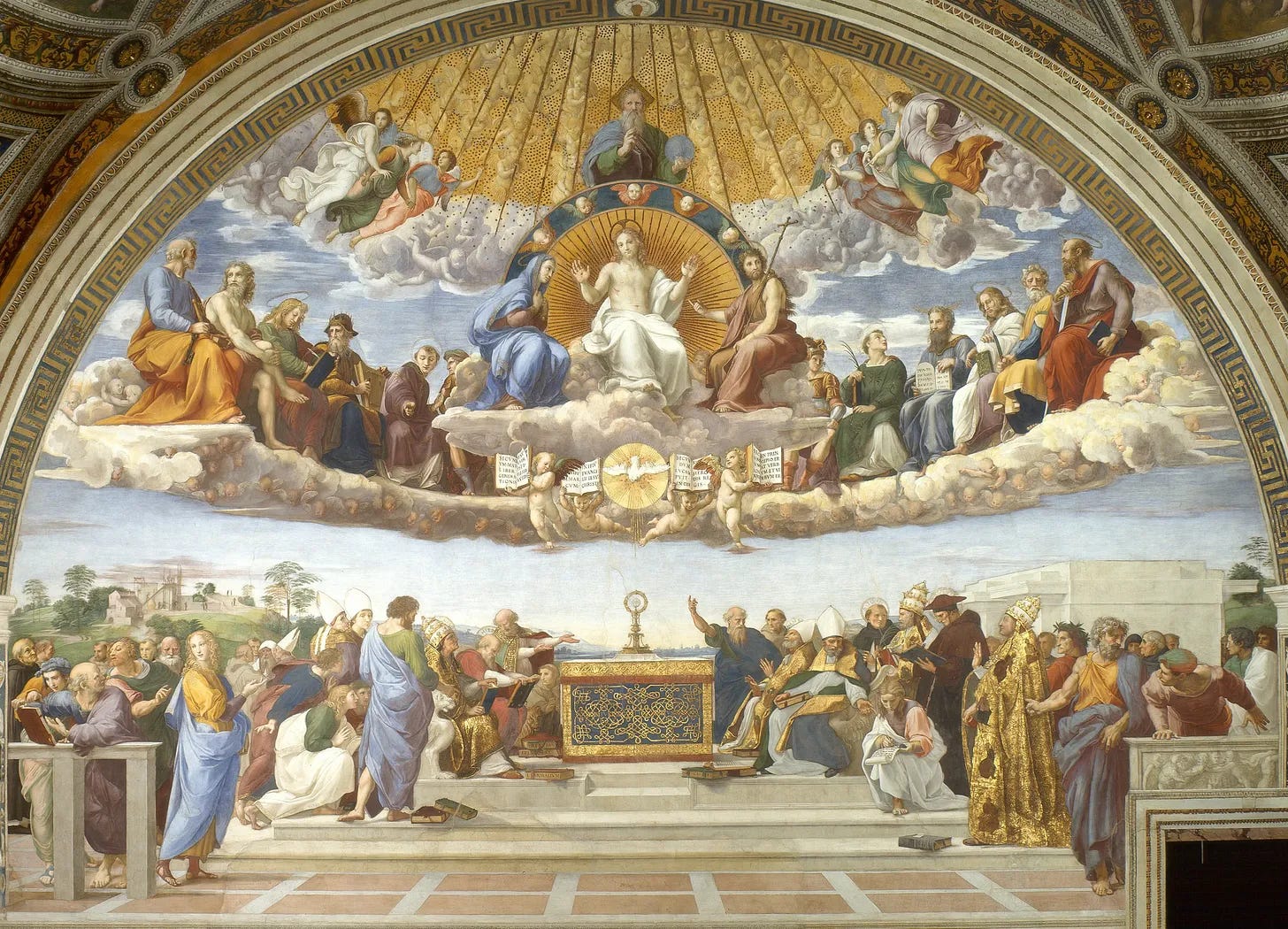
Paul’s first letter to the Corinthians addresses a church in a state of fragmentation: a timely concern for our day and age.
“What I mean is that each one of you says, ‘I follow Paul,’ or ‘I follow Apollos,’ or ‘I follow Cephas,’ or ‘I follow Christ.’ Is Christ divided? Was Paul crucified for you? Or were you baptized in the name of Paul?” — 1 Corinthians 1:13-14
This is ugly, and Paul deals out his reproof unsparingly. Nobody is off the hook here, not even those who declare “I follow Christ” as a way of putting down their brethren.
We later learn that this fragmentation has infiltrated and disrupted the Corinthians’ celebration of the Lord’s Supper. Here it becomes apparent moreover that the problem is not merely a crisis of truth; it is a crisis of charity.
“But in the following instructions I do not commend you, because when you come together it is not for the better but for the worse. For, in the first place, when you come together as a church, I hear that there are divisions among you. And I believe it in part, for there must be factions among you in order that those who are genuine among you may be recognized. When you come together, it is not the Lord’s supper that you eat. For in eating, each one goes ahead with his own meal. One goes hungry, another gets drunk. What! Do you not have houses to eat and drink in? Or do you despise the church of God and humiliate those who have nothing? What shall I say to you? Shall I commend you in this? No, I will not.” — 1 Corinthians 11:17-22
This passage may be understood to justify the rationale of “closed communion,” i.e., a local church excluding believers of differing confessions from partaking of their own tables. The reasoning generally runs that communion should be a time of doctrinal purity and unity, that to admit even a convictional believer obedient to the dictates of the authorities in the church of that believer’s own membership, if that other church’s confession is sufficiently distinct on significant points, would be a kind of adulteration of the feast, or pastorally irresponsible. In short, shared communion becomes the end goal of church unity efforts, rather than the basis.
I would like to challenge that rationale.
The word rendered here as “genuine,” elsewhere better translated as “approved,” comes from the Greek root δόκιμος, dokimos. This indicates acceptance by God (cf. 2 Corinthians 10:18, James 1:12).
When Paul recognizes the necessity of division in the church, he isn’t talking about the difference between kinds of believers. He’s talking about the difference between believers and non-believers.5 That is a true basis for severed communion (2 Corinthians 6:14-18).
Paul goes on in the present text, 1 Cor. 11, to recite the words of Christ by which He instituted the Supper, pointing out that we are proclaiming the message of Christ’s death. He has already defined it as a participation in the foregoing chapter, in addition to being a memorial.
After presenting the Words of Institution, Paul provides a severe warning against partaking unworthily; his language is strong and sobering.
“Whoever, therefore, eats the bread or drinks the cup of the Lord in an unworthy manner will be guilty concerning the body and blood of the Lord. Let a person examine himself, then, and so eat of the bread and drink of the cup. For anyone who eats and drinks without discerning the body eats and drinks judgment on himself. That is why many of you are weak and ill, and some have died. But if we judged ourselves truly, we would not be judged. But when we are judged by the Lord, we are disciplined so that we may not be condemned along with the world.” — 1 Corinthians 11:27-32 [Emphasis added]
I’d like to call attention to three statements in parallel here:
“examine [δοκιμάζω, dokimazō] himself…” (vs. 28)
“…discerning [διακρίνω, diakrinō] the body…” (vs. 29)
“…judged [διακρίνω, diakrinō] ourselves…” (vs. 31)
It’s a fascinating and confusing knot of statements which I don’t intend to fully untangle, but there’s a significant point to be discovered. The central statement seems to speak comprehensively. We partake unworthily if we are not discerning the body.
What does it mean to be discerning the body?
Those who hold to various formulations of bodily presence in the Eucharist will see this statement as an affirmation of that doctrine. I’m not here to take a position on the mode of Christ’s presence in the Sacrament. I’m simply pointing out a broader implication—what Paul’s statement means for how we treat one another as believers.
You see, this central statement is sandwiched between two much more definite instructions which are comprehended within discerning the body. First, we are to discern ourselves as members of Christ’s body individually (vs. 28). The word here, dokimazō, related to dokimos (see above), is about approving—seeing whether we are in Christ (i.e., a believer, walking in repentance). Every individual communicant must first recognize himself or herself as in Christ, or else that person cannot worthily partake.6 Second, we are to discern ourselves as members of Christ’s body collectively (vs. 31). The word here, diakrinō, connotes separating, making a distinction, discriminating, just as in the central statement of vs. 29. The grounds for this collective distinction are no different: are you together recognizing all those who are in Christ?
To put it another way, this is my body isn’t just about the bread.
The implication is simple. If you would call someone a believer, you must accept that person at your table.7 8 If we fall short of this standard, we fall under the discipline of God.
To refuse someone from the Lord’s Table is to call that person, for all intents and purposes, outside of Christ—an unbeliever (Matthew 18:15-17). Even in that extremity, our goal, and the goal of excommunication, ought to be restoration (1 Corinthians 5:5).
Brothers and sisters, how can we call one another brethren if we exclude one another from communion? Do we claim authority to reject the one accepted by Christ?
“Little children, let us not love in word or talk but in deed and in truth.” — 1 John 3:18
The Epiphany of Emmaus
If we desire that the injured body of Christ be healed, we would do well to heed the words of a physician.
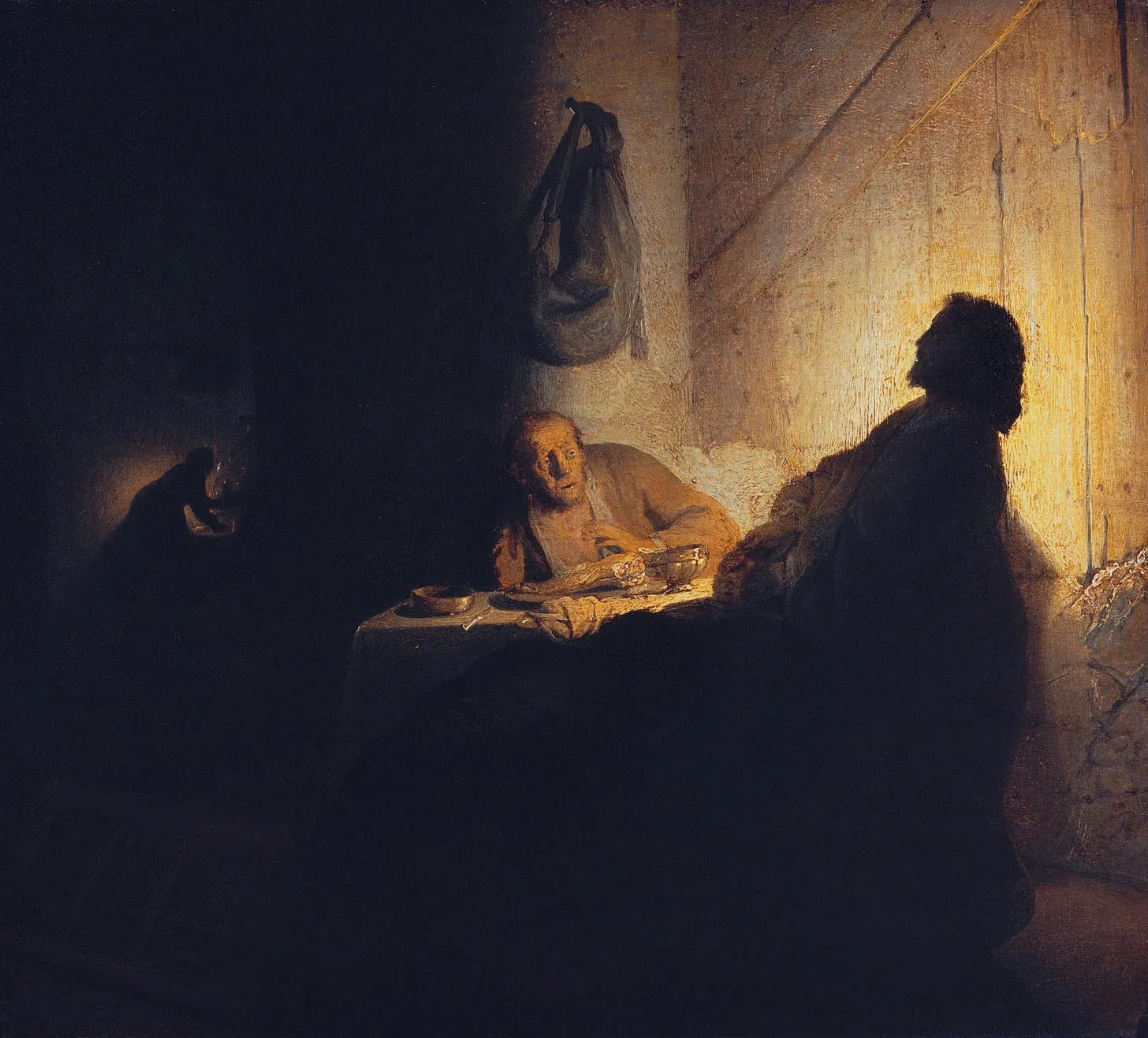
Near the end of Luke’s Gospel, the author recounts a tantalizing anecdote. In the aftermath of the Crucifixion, two disciples—Cleopas and another—were walking and talking dejectedly on the way to the village of Emmaus, a few miles outside Jerusalem. Presently, they found themselves accompanied by a third.
One wonders how this mysterious figure might have appeared to their eyes. Were his clothes tattered and soiled, wayworn? Repulsive, or merely nondescript?
What sort of person did the disciples suppose him to be? A beggar? A bandit? A tax collector? Or worse, a foreigner?
At any rate, he certainly seemed ignorant.
“Then one of them, named Cleopas, answered him, ‘Are you the only visitor to Jerusalem who does not know the things that have happened there in these days?’” — Luke 24:18
It was the third day since the Crucifixion. Everybody knew about the Crucifixion, that was three days ago, over and done. The guy who claimed to be the Messiah, the one starting to get some traction with the crowds, had been killed. Yet again, Rome had indomitably crushed the aspirations of the dreamers. Cleopas and his friend had heard about the empty tomb, true, but that was only a rumor. They didn’t know what to make of it. They hadn’t seen with their eyes. To judge by their words, they weren’t feeling optimistic.
“But we had hoped that he was the one to redeem Israel.” — Luke 24:21a
Do you hear the disappointment? Had hoped.
The stranger responded with a rebuke. Then—surprisingly!—he began to teach them from the Scriptures, expounding powerfully upon prophecy. What business did this rogue evangelist have being so brilliant with joy? Who did he think he was? At any rate, he knew the Scriptures; moreover, he wielded them to effect. The disciples found themselves… discomfited. Of that lesson, they would later say, “Did not our hearts burn within us?” (Luke 24:32).
And so they came to their lodging place. The stranger indicated that he would continue on his way, saving them the awkward business of ridding themselves of his company. In that moment, Cleopas and his friend made a decision—“Stay with us,” they asked, “for it is toward evening and the day is now far spent” (Luke 24:29b).
So the stranger stayed.
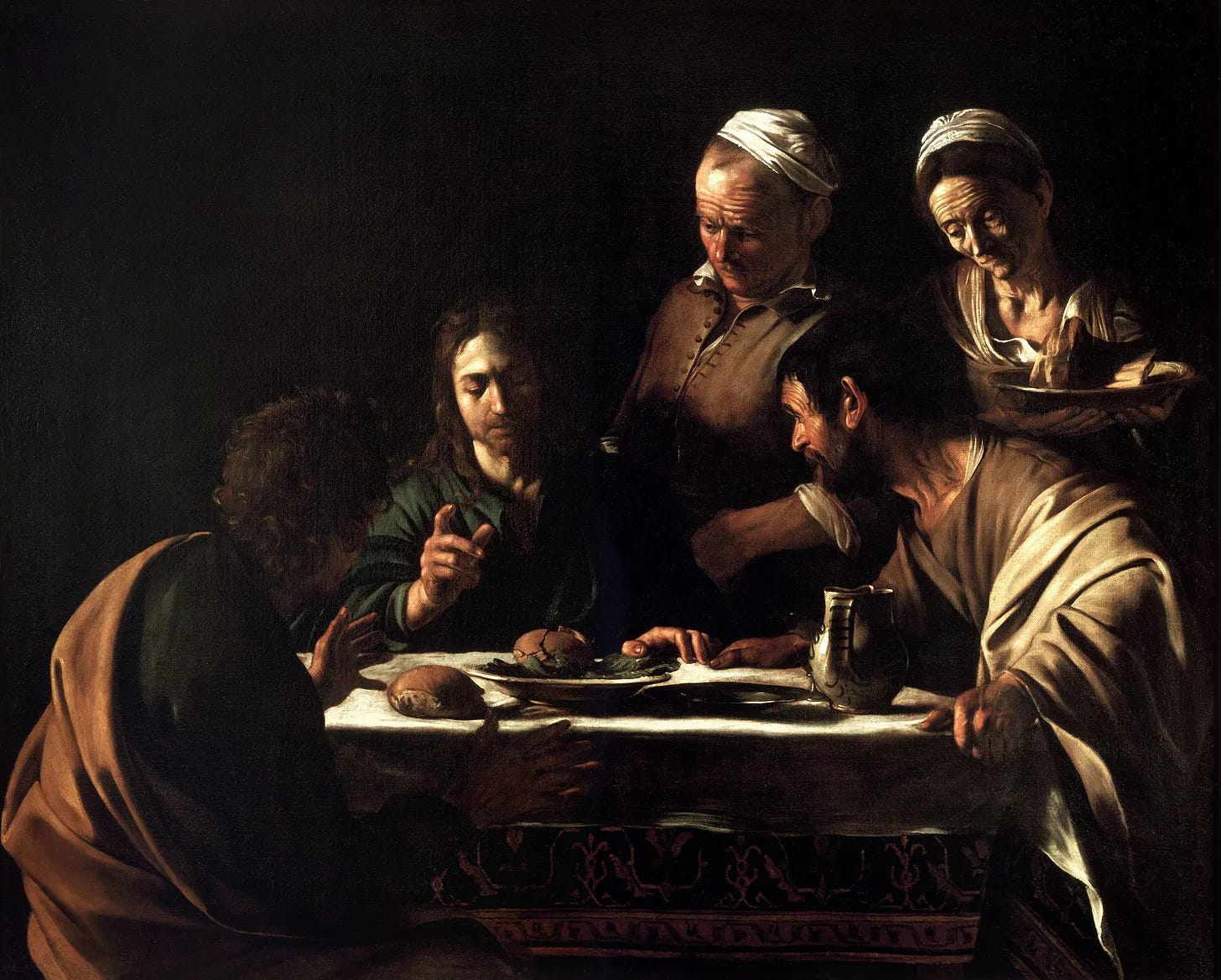
As they reclined around the table later that evening, spreading forth their meager provisions, the stranger performed a mundane gesture—perfectly mundane, and yet nonetheless invested with startling significance to those haunted by the memory of the last meal they had shared with their Teacher. The one where he’d said this is my body. The stranger reached for the bread, took it in his hands, asked a blessing, and broke it, passing around the portions to his fellows.
“And their eyes were opened, and they recognized him. And he vanished from their sight.” — Luke 24:31
One momentary glimpse of the risen Lord. What might this curiously evasive passage mean for the Eucharist? We come to the table to recognize Christ in the brother by our side.
And in Christ, the disciples encountered hope.
“Then they told what had happened on the road, and how he was known to them in the breaking of the bread.” — Luke 24:35
Not One Of His Bones Will Be Broken
Looking around at the dismal state of Christian unity, it’s easy to feel dispirited.
The painful rift of Marburg was only one instance. Formal schism has existed for a thousand years. Bitter tensions and conflicts have wracked the church from the time of the Apostles onward.
Maybe we think the unity Jesus prayed for (John 17:20-26) isn’t possible. Maybe we think domineering authority is the only thing that can bring us together—that the world’s playbook works, and the way of Christ doesn’t. Maybe we doubt the worth of charity and the effectual work of the Spirit. Maybe we become historical pessimists. Maybe we build up pride in our own camps, putting down one another, forging a counterfeit unity out of those who won’t make us too uncomfortable, or maybe we find ourselves tempted rather to give up on dearly-held Scriptural convictions, resigning ourselves to confusion and uncertainty.
What grounds do we have to hold out hope?
It’s ironic that the meal of the broken body of Christ so often seems to end up… breaking the body of Christ.
But is it really proper to say His body was “broken”?
Whenever I find myself grieved by divisions in the church, I take comfort in remembering that there’s a deeper reality at work. More holds us together than mere circumstance; a richer Life than our own indwells us. In Christ’s hour of suffering, yes, His flesh was much injured—lashed, lacerated, flayed, impaled, crucified—but even so, there was a kind of essential bodily integrity which was not permitted to be violated.
“Since it was the day of Preparation, and so that the bodies would not remain on the cross on the Sabbath (for that Sabbath was a high day), the Jews asked Pilate that their legs might be broken and that they might be taken away. So the soldiers came and broke the legs of the first, and of the other who had been crucified with him. But when they came to Jesus and saw that he was already dead, they did not break his legs. But one of the soldiers pierced his side with a spear, and at once there came out blood and water. He who saw it has borne witness—his testimony is true, and he knows that he is telling the truth—that you also may believe. For these things took place that the Scripture might be fulfilled: ‘Not one of his bones will be broken.’” — John 19:31-36
This claim about the bones has always intrigued me. There’s something oblique and fascinating about it—some suggestion of a grand significance not immediately apparent. What’s the point?
Not one single bone was broken, Scripture testifies—not a rib? Not one of those itty bitty ones in the toes, so easy to crush? Not the wrist-bones, with an iron spike driven between?
This, even despite all the powers of Hell being unleashed against Him. Imagine lowering a man into a moiling pit of lawn-mowers, Jurassic Park-style, and lifting him out again, only to see the old clothes perfectly cut away from his untouched skin, not a single bleeding scratch to be discovered, with a fresh haircut and a clean shave besides! That, to my mind, is the sort of precision conveyed by this prophecy.
Do you see, now, the hand of the Father over every minute circumstance which befell His Son?
Do you see Him lovingly preserving His own, even through the hour of trial?—even when it seemed His adversaries would rip His body apart? Even when it seemed they had succeeded?
Brothers and sisters, let us keep the faith.
“Blessed is that servant whom his master will find so doing when he comes.” — Matthew 24:46
Bibliography
Beto, George John. “The Marburg Colloquy of 1529: A Textual Study.” Concordia Theological Monthly 16 (February 1, 1945). Accessed February 25, 2026. https://scholar.csl.edu/cgi/viewcontent.cgi?article=2847&context=ctm.
Calvin, John. Institutes of the Christian Religion. Vol. 2. Translated by John Allen. New York: Robert Carter & Brothers, 1845. Accessed March 9, 2026. https://www.gutenberg.org/ebooks/64392.
Concordia Publishing House. Formula of Concord: Epitome. In The Book of Concord. St. Louis, MO: Concordia Publishing House. Accessed March 13, 2026. https://bookofconcord.cph.org/en/formula-of-concord-epitome/vii_the_holy_supper_of_christ/.
Justin Martyr. “The First Apology.” In Ante-Nicene Fathers, edited by Alexander Roberts and James Donaldson, 159–187. Buffalo, NY: Christian Literature Publishing Co., 1885. Accessed March 9, 2026. https://archive.org/details/antenicenefather01robe/page/184/mode/2up.
Ligonier Ministries. We Believe: Creeds, Catechisms, and Confessions of Faith. Sanford, FL: Ligonier Ministries, 2023.
Luther, Martin. Letter to Katharina von Bora, October 4, 1529. In Martin Luther’s Letters, transcribed at Lutherdansk. Accessed February 25, 2026. http://www.lutherdansk.dk/Web-Luther’s%20Letters/Martin%20Luther%20-%20Letters%203.htm#_Toc106560561.
Luther, Martin. Luther’s Small Catechism with Explanation. St. Louis, MO: Concordia Publishing House, 2017.
Luther, Martin. Table Talk. Translated by William Hazlitt. Grand Rapids, MI: Christian Classics Ethereal Library. Accessed March 9, 2026. https://ccel.org/ccel/luther/tabletalk/tabletalk.
Osiander, Andreas. The Marburg Colloquy—Report by a Lutheran Eyewitness (1529). Translated by Ellen Yutzy Glebe. In German History in Documents and Images. Accessed February 25, 2026. https://germanhistorydocs.org/en/from-the-reformations-to-the-thirty-years-war-1500-1648/the-marburg-colloquy-report-by-a-lutheran-eyewitness-1529.
Zwingli, Ulrich. “An Exposition of the Faith.” In Zwingli and Bullinger, edited by G. W. Bromiley, 257–286. Philadelphia: The Westminster Press, 1953. https://archive.org/details/thelibraryofchristianclassics/mode/2up.
Zwingli, Ulrich. The Marburg Colloquy—Ulrich Zwingli’s Report (October 20, 1529). In German History in Documents and Images. Accessed February 25, 2026. https://germanhistorydocs.org/en/from-the-reformations-to-the-thirty-years-war-1500-1648/the-marburg-colloquy-ulrich-zwingli-s-report-october-20-1529.
Osiander notes that the Lutherans would have been open to a broad recognition on the part of the Reformed:
“He [Philip] found in every case that if they [the Swiss] would confess the part that the body of Christ is present in communion and not just a human commemoration, then we would dismiss the other questions and not pressure them whether this was a bodily or spiritual, natural or supernatural presence, with or without a fixed location. We would thus accept them as brothers and do everything that he [the prince] wanted. But (this is surprising to hear) they did not want to do so.”
Although the Reformed/Calvinist tradition would move in this direction, affirming and emphasizing a spiritual partaking, the Lutheran tradition would go on to codify their “in, with, and under” formula in a way that largely excludes expressions which apparently would have been acceptable to the founders at the time of the Marburg Colloquy. Closed communion (by which I mean the exclusion of an alleged Christian of a significantly differing confession from the Lord’s Table of a certain church body) is a reality in many branches of the church and not confined to one tradition, with lines variously drawn.
Compare: Augsburg Confession, Article X; Formula of Concord: Epitome, Article VII; Heidelberg Catechism, Questions 75-80; Belgic Confession, Article 35.
Luther would state the following position after Zwingli’s death, as recorded in his Table Talk, DCCLVII:
“I wish from my heart Zwinglius could be saved, but I fear the contrary; for Christ has said that those who deny him shall be damned. God’s judgment is sure and certain, and we may safely pronounce it against all the ungodly, unless God reserve unto himself a peculiar privilege and dispensation. Even so, David from his heart wished that his son Absalom might be saved, when he said: ‘Absalom my son, Absalom my son;’ yet he certainly believed that he was damned, and bewailed him, not only that he died corporally, but was also lost everlastingly; for he knew that he had died in rebellion, in incest, and that he had hunted his father out of the kingdom.”
Caveat: I humbly recognize that different branches of the church hold differing opinions on which doctrines are essential. Trinitarian theology, an outgrowth of the essential confession of Christ’s divine nature and human nature (Matthew 16:16; John 20:28), is the primary area where many heresies were ecumenically defined before schism fragmented the church, although there are disagreements among Christians on some particularities of the Trinitarian formula.
I am not taking a position on church polity here. I am not arguing for or against a local church body’s autonomy, and I affirm that the shepherds of individual congregations have a responsibility to uphold pure doctrine for those under their authority. I am merely arguing for the unity of fellowship as recognized by shared communion; in other words, to stop leveraging the Eucharist as a tool for division against those we claim to be fellow believers.
The Westminster Larger Catechism expresses well a very pastoral caveat to this requirement:
Q. 172. May one who doubteth of his being in Christ, or of his due preparation, come to the Lord’s Supper?
A. One who doubteth of his being in Christ, or of his due preparation to the sacrament of the Lord’s Supper, may have true interest in Christ, though he be not yet assured thereof; and in God’s account hath it, if he be duly affected with the apprehension of the want of it, and unfeignedly desires to be found in Christ, and to depart from iniquity: in which case (because promises are made, and this sacrament is appointed, for the relief even of weak and doubting Christians) he is to bewail his unbelief; and labor to have his doubts resolved; and, so doing, he may and ought to come to the Lord’s Supper, that he may be further strengthened.
Once again, I am not denying the need for doctrinal clarity nor the value of precise confessions. Nor am I criticizing the following of due process for a church body to confirm the genuineness of the faith of those under its own authority (e.g., asking for unbaptized new converts to be baptized before communing, or parents withholding their children until they are confident in the child’s maturity of faith). I am not even taking a position on by what standard we should recognize an individual as being “in Christ.” Different church leaders may land in different places. I am merely arguing that if we make that declaration about someone, by whatever standard, we ought to follow through in permitting them to receive the Sacrament. To do otherwise is inconsistency. I will further add that it is a grave spiritual danger to deny the work of the Spirit in another individual’s life, where He is present (Matthew 12:22-32); however, there are valid disciplinary reasons for treating someone as though they were an unbeliever (Matthew 18:17).
I am arguing for each of us to approach or administer the Lord’s Table in a spirit of welcome toward our brothers and sisters in Christ, insofar as it lies within our authority. I affirm that laypersons should respect the Biblical authority of their shepherds (Hebrews 13:17). I am advocating for orderly renewal, not overthrow of authority.
 | A guest post by
|