

"Let my imagination wither!"

Imagine nothing.
You don’t need to try and imagine blackness or a vacuum, since those are something. You need only distract yourself, and your mind will take care of the rest. By which I mean, your mind will do nothing at all.
Watch TikTok and you will imagine… nothing.
By now, we are all familiar with this numbing effect of borderline (or full-blown) senseless media. I need not tread ground that others have gone before me so often the grooves in the road are deep.
Instead, I would simply like to remind you (or myself, actually) that our capacity to imagine is not innate. It is not a given. It is natural, of course, a near-universal human experience. But without use it can grow lethargic and waste away.
I feel it when weeks are stressful.
I am not like some creative writers who thrive on high emotion. The muse does not arrive for me when I’m grieving, lost, or confused. When life overwhelms me, threatens to smother me whole, I desire only to flee—to escape to something that won’t let me think and dwell. That won’t let me imagine.
It takes every bit of Christian maturity in me to just keep praying.
Prayer: the most underrated implementation for the sanctified imagination. Prayer is where my mind is fully engaged and my imagination is forced to run wild and rampant as the worst and best of me is laid bare before God.
My body might be kneeling and still, but my mind is a jungle.
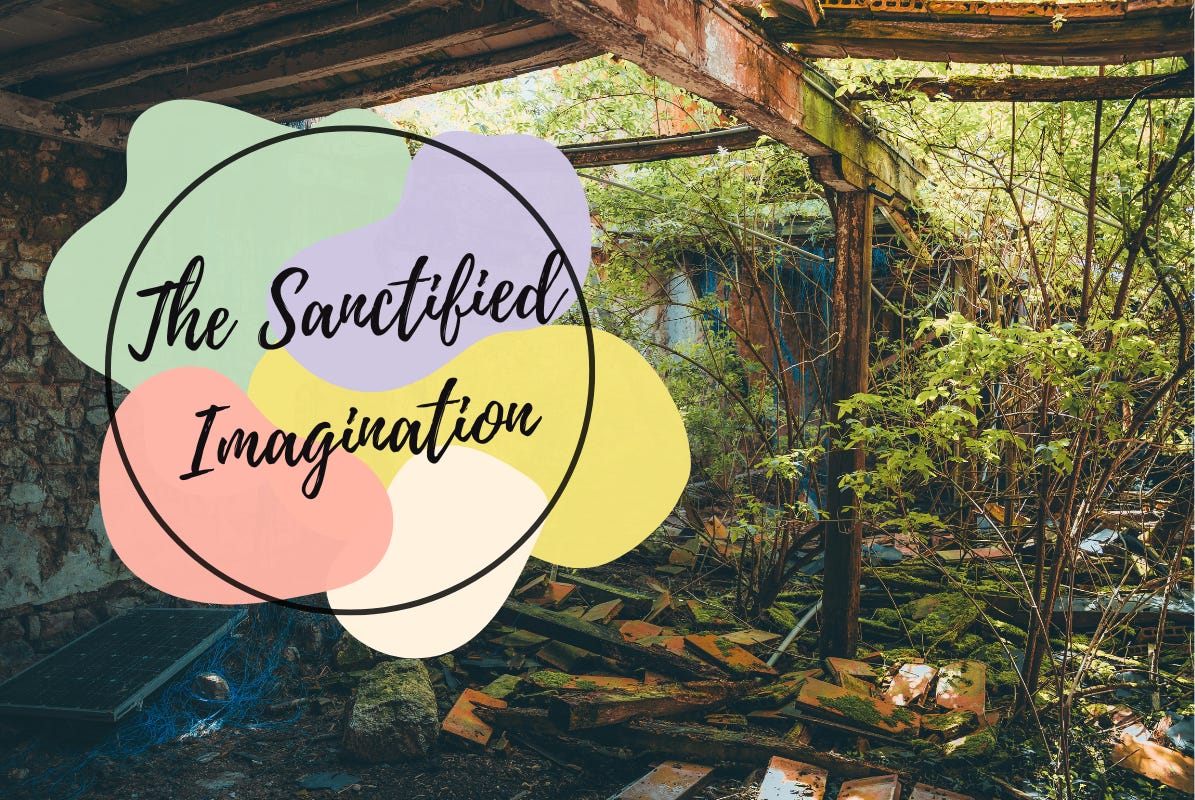
It’s all wild trees and flowers amidst roaming animals and an ever-present hum of crickets and cicadas. Dangerous, chaotic, and in need of gardening. Perhaps that’s what prayer is, in part—inviting God to come tend the garden of our mind.
Instead of that, I’m tempted to go to the bathroom with phone in hand, intent on filling even porcelain solitude with more noise so that I don’t have to confront that mental mess of a garden.
It’s as though some part of me wants to throw my hands up and yell, “Just let my imagination wither, for all I care.” Better than disciplining myself and trying to use my imagination. Better than trying to tame it. Sanctify it. Just let my mind-garden become a jungle.
I said “better”, but I should have said “easier”.
Later, I’ll act shocked and annoyed when writing comes hard—words dragged out from thorny underbrush and covered in ticks.
My imagination was a thriving garden just a day before. I walked peacefully beneath the boughs of trees and put four thousand (not too shabby) words down on the page of my book.
Then stress. Then worry. Then phone and music and numbing. Grass grows high. Wild flowers consume. Leaves go unraked. Racoons move in.
Mind-gardens have a way of becoming overgrown rather quickly. Constant tending is required for healthy imaginations.
After some time, I’ll get the whole thing in order: my imagination ready to write stories, to empathize with people, to think up acts of creative love. God helps with the clean up of our jungles, thankfully.
But how I mourn for those who do not even know this cycle exists. Whose imaginations are both overgrown jungles and atrophied muscles. For some, the work has not been done since childhood, for the gardener is always occupied with Netflix, ESPN, TikTok, Fortnite, and whatever else.
Neither the gardener nor the Gardener are there to do the tending.
Perhaps they look out at the mental window occasionally, gazing at the mess that is their thought-life. They lay on the pillow and try to sleep, thoughts roaming and roaming. They’ll see shadows of past events in the shadows cast by tree branches. They’ll long to close the window of their mind, scrolling elsewhere to stare out into anything else.
But not you, friend. Not today, at least.
Let us kneel and pray, holding fast to the silence and willing ourselves to enter into the underbrush of our imagination with a machete. Let us go through the hard work, whether needed for an hour or a week, and live in the silence and boredom that allows our minds to cultivate gardens.
Let us do the dishes in silence. Drive in silence. Poop without distraction. Sit on the couch with tea in hand and nothing else. And then, when the time is right, get up and go and create in the garden which now has space for the work.
These must be done together.
Cleaning the garden is good. Taming the wild is good. But flowers must be planted in the empty soil, a bench must be positioned on the path. This is the act of imaginative creating, a logical next step to the taming of the overgrowth.
Silence is taming.
Creating is cultivating.
Imaginations are gardens.
This is by far the best piece I’ve ever read that includes the word “poop”
I think this is my favorite Phil-post so far. Love the poetic and metaphorical handling of such an ethereal topic. Congrats on the progress in your book!