

Okay... but what actually is Christian art?
Or, an Introduction to Christian Fiction

This essay is also available in an (AI-free) video format here.

I am a Christian and I write fiction.1 Do I, therefore, write “Christian Fiction”?
For me, there is no term as strange and vague as “Christian [insert type of art]”2. For most of human history, art was inherently a way of processing and exploring the divine. All art was (and perhaps is) religious.
Today—through many machinations and interesting movements of history—we have arrived at a time in which “Christian” is a term used for a slice of consumers in the Western market that are primed to buy a specific type of product. How we got here is an interesting study, I’m sure, but not the purpose of this article.
What I’m curious about, is how we, as artists, should consider and define “Christian art”. And, for the sake of this article, I’ll hone in exclusively on the art of storytelling and propose how I think we, as writers, should view the term “Christian Fiction”.
But First, a Story
I was a senior at UCF, taking a course titled “Advanced Fiction Writing”. The course centered around a capstone project—a 20,000 word short story that we would revise throughout the course. Nearing my final draft, my professor sat me down in his office and said, “Phil, you are already writing at a publishable level.”
A “publishable level”.
As someone aspiring to be published (in an era where blogging was the only form of independent publishing), you can imagine the sudden burst of elation I felt at my professor’s words. Alas, it was not long lived.
He continued, “But we need to tone down this religious stuff.”
Important context: I was about a year into following Jesus and about as zealous as new believers come. Because of a love for Jesus and a deep desire to make “Christian fiction”, I was fairly heavy-handed with my religious themes.
Now, in 2026, a statement like my professor’s would seem inflammatory3, but I wasn’t insulted nor did I feel persecuted. I felt challenged, and I wanted to understand. The professor and I had an excellent conversation that formed me well, and I am incredibly grateful for his willingness to push me.
You see, my work up to that point demonstrated a solid enough understanding of imagery, character development, pacing, etc. But I was so fearful that I would make something “secular” or “meaningless”, I was forcing the story to take on Christian lessons and allegory so obvious it was painful to read.
In other words, my stories never rang “true”. The felt forced, fabricated. The felt like lies.
Years later, I think I would rephrase what that professor said. It wasn’t that I needed to “tone down the religious stuff”. It was that I needed to tell deeply true stories, and trust the Lord to use them.
Christian Fiction is…
Christian Fiction are stories that, at the deepest and most fundamental level of human experience, are true.4
That’s it. The grand reveal.
Still, I think this definition takes some digesting, and it contains within it some nuance… and maybe some problems.
To tell a fictional story means to tell a story that has not, in the literal sense, happened. But when a writer sits down and pens a story that has not happened in the literal sense, and yet still aims to capture some deeply true thing about God, others, or this world… they are engaging in a beautiful act of truth-telling.
This was my experience as a reader when I finished my first read through of Till We Have Faces5 and wept. The story of Orual’s journey was fictitious (did not happen in the literal sense), and yet was a near-perfect mirror to my own life up to that point (true on the level of human experience).
It was true, in that the story brought me into intimate proximity with the Truth.
This is art at its most Christian.
But it has to be made by Christians, right?
The first “problem” my proposed definition brings up is this: it does not specify that only Christians can make “Christian Fiction”. But of course, that is implied… isn’t it?
There is a near universal experience Christians have when we encounter a piece of art that is so profoundly “Christian” yet we know nothing of the artist’s beliefs. Diligently, we hop on Google and type, “is [artist name] a Christian?” or “what does [artist name] believe?” or something else. I’ve done it. You probably have too.6
Something in us wants to know if these people “really are” Christian, or if we have just been fooled into seeing something “Christian” where it wasn’t. I did this after hearing "Heavydirtysoul” by Twenty One Pilots and thinking, “there is no way these dudes don’t know Jesus.” Still, I wouldn’ let the art speak for itself. Something in me felt like I had to know if the band was “Christian” in order to know if I was consuming the art as it was intended.
Sometimes we’re happily surprised and find out these people are fellow brothers and sisters in Christ. Sometimes we end in ambiguity (turns out not everyone’s religious beliefs are on the internet). Sometimes we find that the artist is not at all a Christian, and then we may even feel “betrayed”.
The reality is, I cannot always be sure someone who professes faith in Jesus really is a believer. And sometimes God uses a non-believer to do His work. I haven’t the slightest clue who are all the people who created the film Schindler’s List, but that movie had a profound influence on my imagination being shaped more like the Beatitudes recorded in Matthew chapter 5.7
And just because someone is following Jesus, doesn’t mean they are at a place of maturity (or are maybe just not called) to make art that can dig deep and expose Truth. Personally, it took me ten years of diligently following the Lord and studying the novel-writing craft before I believe I could partner with the Lord in writing stories that are true on the most fundamental level of human experience.
In the interim, the art I made was often very “un-Biblical” in that it was sanitized to the point of being fake.8
An Example
Consider two films side by side.
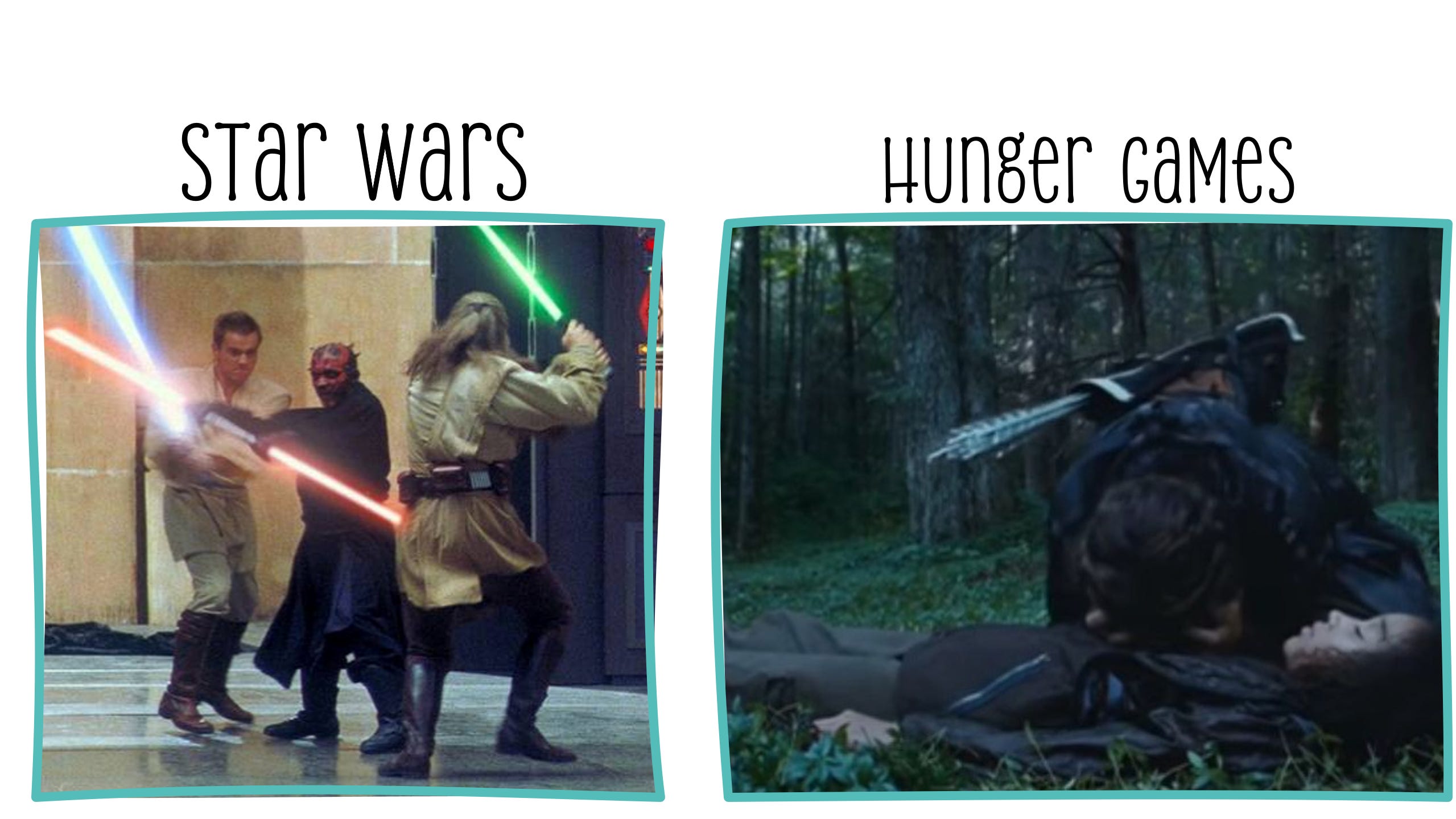
Now, I have been a huge Star Wars fan in the past9, and I can tell you that the lightsaber duel at the end of Episode I: The Phantom Menace is top tier. Beautifully choreographed with fantastic cinematography, and a killer musical score behind it. But if you think about it for just a second… it’s also sad. People engaging in an act of violence so savage as to literally chop one another limb from limb… it’s horrific.
But the movie doesn’t make you think of a lightsaber duel as a horrific and sad thing. You are not led into emotions of disgust or grief. On the surface—when viewing the film as it was intended—you see this fight as enjoyably and fun. So much so that I (and tens of thousands of other young boys) asked for a retractable toy lightsaber for Christmas so I, too, could pretend to chop up my brothers and sisters for fun.10
Violence and death is nothing like what Star Wars portrays it as.
It is, however, much like how The Hunger Games books and movies portray it. In this series (books and film, both), death is ugly and tragic. And the process of becoming someone who can kill is dehumanizing, so much so that our main character has to see other humans as animals in order to kill them. Getting to know people (seeing the humanity in others) is perhaps the number one thing that problematizes her chances for survival. To the best of my knowledge, The Hunger Game films did not spawn a line of toy weapons that children wanted to use to reenact death in their own home.11
This isn’t me saying “Star Wars is terrible and you shouldn’t watch it”.
It is me saying, that Star Wars isn’t true art, and thus not “Christian” in the deepest sense of the word.12
Whether or not a book is made by a Christian or is written for a market of people who identify as Christian is very much irrelevant to what I believe is the true definition of “Christian Fiction”.
The question is simply, “is the story true?”
And Yes, Being a Christian Matters
It is true that one does not have to be a Christian to make something that is true at the deepest and most fundamental level of human experience, but I do think it’s the only way to do it consistently.
You see, true art is most often created at the intersection of discipleship to Jesus and a disciplined pursuit of craft.
When a human is following Jesus as a disciple and—because of a calling from Jesus—they are diligently working to hone their craft, then they are bound to create Christian art over and over again.
But both discipleship to Jesus and discipline to the craft are vital components. Neither can be sacrificed and still leave a legacy of Christian art (as we have defined it here).
When there is discipleship but no discipline to the craft, you get art that is poor and flavorless. It turns people away, and rightfully so. Of course there must be a stage of this in someone’s life, and we need a safe community who will lovingly bear with us (like my professor in college). But that community is not loving if they say, “this is good” when it is truly bad. They are loving when they say, “this is bad, but I love you and want to help you make it better”.
Excellence in craft with no discipleship to Jesus is worse, because it most often (though not always) leads to art that is both sweet and deadly. Like perfectly grown and processed tobacco that is “artistic” in its creation and presentation… it is still a carrier of cancer and death.13
But we do not have to choose a lesser evil.
Christians who take discipleship to Jesus seriously will love their neighbor well, and loving your neighbor well means learning the craft.
I can’t bake. Not at all. I’m terrible at it, and so it isn’t loving for me to make a cake and ask my community to eat it just because “I’m Christian”. I either need to learn to bake well and then serve my community through baking, or I need to do something else.
Writing stories is similar. Simply not everyone is called to it, and those who are called will not be good at the start. Stories should not be shared widely until the writer has grown into excellence. It simply isn’t loving to market a poor book and ask people you don’t know to read it. A new writer needs a small group of people who will love them enough to read their crappy fiction, tell them why it sucks, and then celebrate when the next draft is less terrible. And then, after years and years, that writer will write a story that makes—for just a little while—that close-knit community forget who wrote it. The story will come alive and the writer will disappear… and that’s how they know they are ready to write for a wider community.
Everyone is called to disciple under Jesus.
Not everyone is called to write stories. Those who are called must place themselves under discipline to the craft so that they may serve and love others well.
In addition to my essays, of course.
Like, “Christian music” or “Christian fiction”.
Consider The Coddling of the American Mind by Greg Lukianoff and Jonathan Haidt
Christian art is art that, at the deepest and most fundamental level of human experience, is true.
An excellent novel by C.S. Lewis. I tell this particular story in more detail in my article Fourteen Years Later.
And if you haven’t, well good on you I suppose.
Specifically, it made me mourn and begin to desire true righteousness on this earth.
I write fantasy/sci-fi, so there is a strong argument that being a Star Wars fan is a pre-requisite.
It is true that some have done good work processing stories like Star Wars and coming away with deeper, even “Christian” themes. However, there is no meaningful evidence that this was Lucas’ intention with his fight scenes, and finding Biblical themes in secular media is for another post.
Of course, it did help popularize other media, such as the “Battle Royal” genre in video gaming. However, someone creating art that is an intentional distortion of another art is not something I think the primary artist bears responsibility for.
Side note: It is possible for a Christian to view Star Wars and pull out Christian themes. That is wonderful and should be commended, but it is going beyond the obvious intent of the creator.
Of course, this is not always the case (just like sometimes someone who has not studied the craft can make something wonderful). However, this is the tendency for art made outside discipleship to Christ.
I've read some very poorly "baked" Christian fiction. One literally took a "Bible break" by saying something like "one of the passages of Scripture that gave him comfort during this time was. . ."
That's just lazy and sloppy. That's putting icing on a burned cake. I started referring to this style of writing as "We now pause for a message from our Savior."
The book of Esther never mentions God, but reflects His nature in a powerful way. Fiction can do the same.
I've heard instrumental music that glorifies God, and songs that quote (or misquote) Scripture that do not. The same can be true of fiction (or non-fiction, or poetry).
You bring up some excellent points. As Christians, it is our task to write stories are true and recommend more for others to read. When we say we're pursuing art that is "good, true, and beautiful," I doubt we really let ourselves realize what we really mean by true. Thank you for highlighting that for us!