

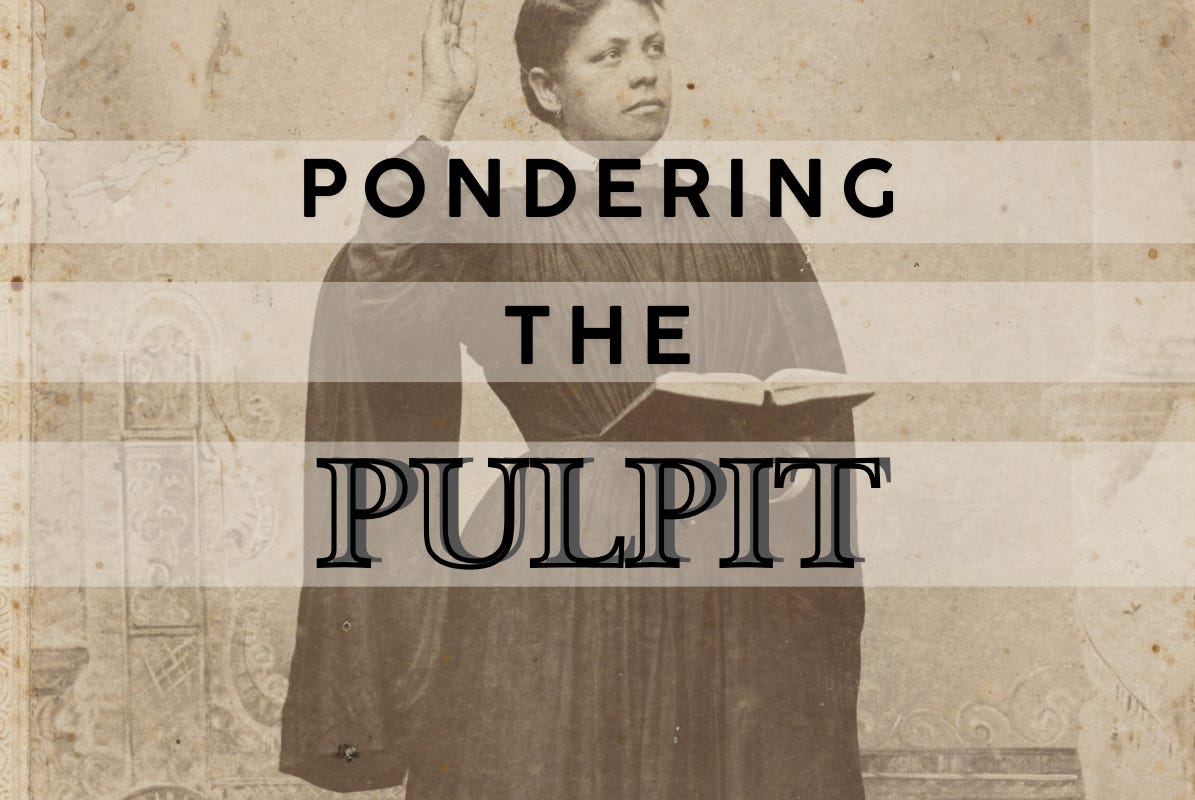
Pondering the Pulpit
Or, "On Demands of Conscience and Charity"

I am currently reading C.S. Lewis’ “The Great Divorce”. In the portion I read last night, our main character witnessed a conversation between a Ghost and a Spirit. In life, these two had been friends and scholars who often debated elements of theology. The Spirit informs the Ghost that he (the Ghost) has been in Hell, but now has the chance to repent and believe.1
Here is an excerpt from near the beginning of their conversation.
“But you don’t know? You were sent there [to Hell] because you are an apostate.”
“Are you serious, Dick?”
“Perfectly.”
“This is worse than I expected. Do you really think people are penalized for their honest opinions? Even assuming, for the sake of argument, that those opinions were mistaken?”
“Do you really think there are no sins of intellect?[…] It all turns on what are honest opinions.”
“Mine certainly were. They were not only honest, but heroic. I asserted them fearlessly. When the doctrine of Resurrection ceased to commend itself to the critical faculties which God had given me, I openly rejected it. I preached my famous sermon. I defied the whole chapter. I took every risk.”
“What risk? What was at all likely to come of it except what actually came—popularity, sales for your book, invitations, and finally a bishopric?”
“Dick, this is unbecoming of you. What are you suggesting?”
“Friend, I am not suggesting at all. You see, I know now. Let us be frank. Our opinions were not honestly come by. We simply found ourselves in contact with a certain current of ideas and plunged into it because it seemed modern and successful.[…] You know that you and I were playing with loaded dice. We didn’t want the other to be true. We were afraid of a crude salvationism, afraid of a breach with the spirit of our age, afraid of ridicule, afraid (above all) of real spiritual fears and hopes.”
It’s important to note that the Ghost’s intellectual sin was related to a core element of faith—whether or not the resurrection of Christ was real. And yet, as I prepare to embark on a series of essays about issues of theological tension and conflict in the modern western church, I cannot help but feel as though I have often been very like the Ghost. No, I’ve never doubted the Resurrection, nor anything outlined in the Apostles' or Nicene Creeds, yet I’ve perpetually played “with loaded dice”. For the first ten(ish) years of my faith, I was defending things I wanted to be true rather than honestly beseeching the Scriptures and the Spirit to discern what is true.
Correction came for me (as it often does) in an area that was entirely separate from theological debate.
I was working a job in which I had deep conflicts with my manager, and I was handling those conflicts as I would anything else—debating, berating, and arguing. I was right, he was wrong, and I had to make that clear. One night I dreamed I was in a prison, and he was the jailer. I tried to free myself, but couldn’t. But the jail wasn’t a jail, it was a school. When I woke, I knew the exact meaning of the dream as though God had spoken it directly into my mind.
I was imprisoning myself to this man.
Unsurprisingly, the Spirit led me to John 17 (I “happened” to be in that passage during my read through of John). This chapter records the prayer that Jesus prays with His disciples before going to Gethsemane, and eventually the cross.
“I am not asking on behalf of these alone, but also for those who believe in Me through their word, that they may all be one; just as You, Father, are in Me and I in You, that they also may be in Us, so that the world may believe that You sent Me.”2
The world will believe that Jesus was sent by God if believers (of whom my manager was one) would be “one” just as Jesus and the Father are one. So what was I doing when I divided with this man because of what was “right” and “just” in the workplace?
Functionally, I had been declaring to the world that Jesus was not sent by the Father. That is a false gospel, and my actions had been preaching it. Oh, woe to me and all of us who have done the same. We are wicked and evil, and only Jesus’ alone can save us.
With this in mind, we may tentatively begin conversing about one of the most divisive topics in modern-day western Christianity—whether or not women may be ordained to pastoral ministry.
May God help us.
Some Clarity
For simplicity sake, I’m going to define two important terms as they apply to my journey (and as I think most people understand them). I can assure you that these definitions don’t capture the historical or academic depths behind each, but they are more grounded in the lived experiences of laypeople (like me).
Complementarianism: the belief that men and women are fully equal in identity and value, but that God has created them with different roles in and outside the Church. In practice, this means that there are roles of spiritual authority that women may not hold.
Egalitarianism: the belief that men and women are fully equal in identity and value, which means that they should be able to fulfill identical roles in and outside the Church. In practice, there is an acknowledgment of the differences men and women generally have, and a belief that those differences make the appointment of women into office of authority even more important.
Some Empathy
In all likelihood, you already have a belief about whether or not gender should be a consideration regarding whether or not someone should be appointment to a role, such as “pastor” or “priest”. It is equally likely that you believe you came to this conclusion through searching the Scriptures.
Perhaps you have. Perhaps you are playing with loaded die.
The fact of the matter is, immensely intelligent people who have lived (or are living) Spirit-led lives that have been radically transformed by the Gospel have come down on different sides of this debate.
John Wesley ordained two women near the end of his life, Dallas Willard wrote the forward to How I Changed My Mind About Women in Ministry, and N.T. Wright likewise ordained women during his time of ministry.
Those who believed in some form of restricting women from elements of teaching and leading include (nearly) all our historical forefathers, reformers (men and women), and even more recent thinkers, such as Tim Keller and Francis Chan. In 1948, C.S. Lewis wrote to the broader Anglican church about the dangers he foresaw in ordaining women as priests.
All this to say, each of us should be able to take a deep breathe and say with humility and honesty, “I may be wrong about this,” whatever side of this isle you come down upon. Now, I don’t mean to deify any Christian thinker nor catapult their work to the level of Scripture—God forbid. I only mean to say we should show loving deference and humility to those who have gone before us and whose lives have shown faithfulness and thoughtfulness to Christ.3
This does not mean we cannot hold a conviction, only that it should set healthy boundaries with how we hold such a conviction.
Straw Men & Strong Men
The most notorious intellectual sin (if I can be so bold) I see in this argument, is when people create “straw men”4 of the opposing side in order to justify their point. It is not hard to create (for either side) a story in which we can cast the “other” as having immoral or devilish intent (though perhaps we’ll soften it by indicating they are only ignorant).
Our complementarian brothers are (so the story goes) misogynists who feel safe only in an environment in which they can have power over women. Our sisters in these churches are victims, fooled into a form of oppression that Christ desires to set them free from, if only someone would preach them the good news of egalitarianism.
Our egalitarian brothers and sisters are (so the story goes) incapable of submitting to God’s commands when it does not appear “right in their own eyes” and are simply swept up in the “spirit of this age”.
If only one of those descriptions seemed ugly to you, I ask you to repent. They both should seem appalling, for they both are.
Surely, there are complementarian churches with misogynists leaders who take their authority and lord it over those in their churches, and husbands who do the same in their marriages. They do not have a theology problem, but a heart one. Or, perhaps (more accurately) their theological shortcoming is not in their beliefs about men and women, but their belief about God and power.
And surely there are egalitarian churches caught up in the “spirit of the age”, who came to their conclusions about leadership not because of honest study but because of fear of being a “misogynist”. They will cave to other social pressures (if they haven’t already) out of fears of being called a “bigot” or “homophobic”. They, likewise, do not have a theological shortcoming about men and women, but about their belief about God and power.
We would all do well to read less arguments about why the “other side” is wrong and more about why our brothers and sister who hold different viewpoints than us are still beautiful. Let’s do so now.
The Complementarian Strong Man
In Christ-centered complementarian churches, there is a genuine desire to kill the idol of “power” through the daily disciplines of “service” and “submission”. When they are at their best, they are communities of men and women who are operating in an ongoing mutual submission. Men, appointed by God, assume the roles as the lowliest of servants and give themselves to the “ministry of the word” (see Acts 6). Their brothers and sisters in the community support this work financially through tithes and offerings, as well as through service in all areas of the church community. Men and women “laypeople” provide wisdom and support, and trust the Spirit to lead those who have been tasked to lead the community.
They have thoughtfully come to the decision that women are not appointed by God to roles of leadership and authority, but they may not really know why this is so. Like the Levites chosen as priests, the clan of Judah as kings, or a mixture of Hebrew men as the Twelve Apostles, this community sees leadership and authority as exclusively appointed by God, and they trust that—even though it often seems to not make sense in their eyes. Yet, like the Levites, the kings, and the Apostles, they know these leaders are held to the highest of standards and will face the harshest of judgments, and they try to oversee their leadership duties with the appropriate weight.
The Egalitarian Strong Man
In Christ-centered egalitarian churches, there is a genuine desire to see all people step into the roles the Spirit has for them. When they are at their best, they are communities of men and women who are operating in an ongoing mutual submission. Men and women, appointed by God, assume the roles as the lowliest of servants and give themselves themselves to the “ministry of the word” (once more, see Acts 6). Their brothers and sisters in the community support this work financially through tithes and offerings, as well as through service in all areas of the church community. Men and women “laypeople” provide wisdom and support, and trust the Spirit to lead those who have been tasked to lead the community.
They have thoughtfully come to the decision that women may be appointed by God to roles of leadership and authority, but they are careful to separate someone’s value by what roles or function they fill in the Body of Christ, and to carefully seek the Spirit’s guidance to ensure they are not unduly swayed by the currents of modern culture. They know leaders in the Church are held to the highest of standards and will face the harshest of judgments, and they their leadership duties with the appropriate weight.
But, Phil, you don’t understand…
“I was in a complementarian church, and I watched the abuse.”
“Paul’s teachings are so clear, and to allow a woman to teach and lead men is a sin.”
“The logical conclusion of women not being allowed authority in church is an inherently abusive system.”
“If we cannot trust God regarding what He has said about men and women, we will eventually become just like the culture around us.”
First, to those who have witnessed or been the victim of abuse in the church, please let me extend what grief and mourning I can in this medium. I am truly sorry, and your individual story and pain is not something I can truly hold or understand. I ask only that our Father in Heaven will hold and heal.
I would be a poor brother in Christ if I did not raise the concern that personal pain often becomes a tool for Satan to demonize others. Too often, the sin of men becomes the catalyst for generalization about those who share the same theological stance. Suddenly, the evil desires of a few lead us to believe that all complementarian churches are ticking time bombs of similar abuse. And if that is true, then all such who defend such institutions must be… and on and on it goes.
A similar logic is played out on the other side. There can be a feeling that egalitarian brothers and sisters are willing to play loose with the Scriptures, being moved hither and thither and willing to put together vague arguments based on feeling, perception, and a few tenuous Scriptures (of which you must have deep historical understanding to interpret, but trust me it really means…). And of course, if only Augustine, Luther, Lewis, and Keller had been as “enlightened” as these people with their liberal theology… and on it goes.
To be clear, I don’t understand all the integral arguments, nor the personal experiences of everyone involved. I daresay, no one does. But I would like to take time to explore this often under-appreciated portion of Paul’s letter to Rome concerning food sacrificed to idols, for I think it is intimately relevant here.
A Logical Division
I am in the middle of a multi-year deep dive into the Torah (first five books of the Bible). A good portion of these books (which are functionally the foundational texts for the Hebrew people) is spent discussing the ways that the Israelites are to be set apart from the surrounding nations. These laws are incredibly important to the story of God’s people, and indeed God’s work on earth.
And a good portion of those laws are about what foods can and cannot be eaten.
The first followers of Jesus were Jewish and continued to adhere to these food laws. Jesus hadn’t come to abolish the Law, after all, but to fulfill it (see Matthew 5). But as Gentiles began to also follow this Jewish messiah, the two cultural groups naturally began to clash in their life together. Rome became one of the points in which much of these conflicts came to a head, for it was home to many Jewish and Gentile believers.
I now think those Jewish believers made a very logical assumption5: these Gentiles should adhere to our food laws. Eating together was deeply intimate and important, so how could these Greek converts keep on eating foods God called “unclean” and which Jesus never ate. I am convinced that these Jewish believers weren’t being petty, they were trying to be faithful.
Though, I suppose trying to be “faithful” doesn’t mean we’re always “right”.
Paul corrects this theological belief in his letter to the Romans, essentially saying that Gentile believers do not need to confirm to food laws of the Old Covenant. If Paul was speaking like a modern-day American Christian writer, he’d have ended there, essentially saying, “this is why I’m right and your wrong, now agree with me or you are this or that.”
Instead, Paul ends this way.
Accept the one whose faith is weak, without quarreling over disputable matters. One person’s faith allows them to eat anything, but another, whose faith is weak, eats only vegetables. The one who eats everything must not treat with contempt the one who does not, and the one who does not eat everything must not judge the one who does, for God has accepted them. Who are you to judge someone else’s servant? To their own master, servants stand or fall. And they will stand, for the Lord is able to make them stand.
One person considers one day more sacred than another; another considers every day alike. Each of them should be fully convinced in their own mind. Whoever regards one day as special does so to the Lord. Whoever eats meat does so to the Lord, for they give thanks to God; and whoever abstains does so to the Lord and gives thanks to God. For none of us lives for ourselves alone, and none of us dies for ourselves alone. If we live, we live for the Lord; and if we die, we die for the Lord. So, whether we live or die, we belong to the Lord. For this very reason, Christ died and returned to life so that he might be the Lord of both the dead and the living.
You, then, why do you judge your brother or sister? Or why do you treat them with contempt? For we will all stand before God’s judgment seat. It is written:
“‘As surely as I live,’ says the Lord,
‘every knee will bow before me;
every tongue will acknowledge God.’”So then, each of us will give an account of ourselves to God.
Therefore let us stop passing judgment on one another. Instead, make up your mind not to put any stumbling block or obstacle in the way of a brother or sister. I am convinced, being fully persuaded in the Lord Jesus, that nothing is unclean in itself. But if anyone regards something as unclean, then for that person it is unclean. If your brother or sister is distressed because of what you eat, you are no longer acting in love. Do not by your eating destroy someone for whom Christ died. Therefore do not let what you know is good be spoken of as evil. For the kingdom of God is not a matter of eating and drinking, but of righteousness, peace and joy in the Holy Spirit, because anyone who serves Christ in this way is pleasing to God and receives human approval.
Let us therefore make every effort to do what leads to peace and to mutual edification. Do not destroy the work of God for the sake of food. All food is clean, but it is wrong for a person to eat anything that causes someone else to stumble. It is better not to eat meat or drink wine or to do anything else that will cause your brother or sister to fall.
So whatever you believe about these things keep between yourself and God. Blessed is the one who does not condemn himself by what he approves. But whoever has doubts is condemned if they eat, because their eating is not from faith; and everything that does not come from faith is sin.
Perhaps we should take this to heart. Why do so many spend significant time and effort “calling out” those who disagree with them about matters of church leadership? Surely it is okay to say “I believe this and here’s why”, but it is another matter to say “this is what they believe and here is why they are wrong.” Who are we to judge God’s servants if they are faithfully seeking the Lord? Who are we to say someone is in the wrong if they are trying to serve our Lord in faith?
I am not their master, and neither are you.
It is a sad irony that when we try to extrapolate the heart conditions of our brothers and sisters because of their theological stance, we’ve made such a childish error that we lose the authority to truly call out our brothers and sisters who have shown their heart condition by their actions. When we have made every complementarian a misogynists, no one will take us seriously when we try to call out true misogyny. When we insinuate that all egalitarians refuse to take the Word of God seriously, we lose our ability to call our genuine instances of such churches giving into the way of the world rather than the Word of God.
Some will (rightly) point out that Christians have a long standing history of calling out both abuses in our society and lack of orthodoxy in the Church. Therefore, should Christians not call out others for “oppressing women” in complementarian churches? Or, shouldn’t Christians not call out one another for “disregarding the Scriptures” in egalitarian churches?
When there are specific actions of abuse, those should be called out and brought to account, yes. When there are flagrant disregards for elements of Christian orthodoxy (see the Apostle’s Creed), then those should be called out and brought to account, yes. But when a fellow gathering of believers has a genuine desire to please God, and believes they are living in a way that is pleasing to God (even if we think they are mistaken), then we should allow their Master in Heaven to do as He sees fit with His servants.
Perhaps if we are focused first on submitting to our brothers and sisters in Christ, bearing with them in their journey without judgment and with copious amounts of grace and love, we shall actually persuade some to our side.
Or not. If we only love one another, I’m unsure how much else really matters. For in our love for one another, Christ shall be glorified, and this should always our highest aim.
Going Forward
I would like to end by encouraging readers to check out two wonderful resources. The first is the essay from C.S. Lewis on this topic that I referenced above, titled “Priestesses in the Church?” The second is a rather short, but splendid, video by N.T. Wright. In it, he argues that this issue isn’t one to divide the church over, but to live in a way that “does not make demands on one another’s conscience, but may make demands on one another’s charity.”
Perhaps that’s what I’ve been trying to say this whole time, but with many (many) more words.
I (Phil) try to avoid topics in which Living Room Disciple doesn’t have an organizational stance. We have a Gospel-centered, but theologically rich, team of people who may not agree with all my thoughts (and praise the Lord for that!).
With that in mind, I thank the numerous people who read this piece ahead of time to ensure it stayed thoughtful and respectful. To my wife, Brittany, who helped me clarify my thoughts. And to my mentor, Cindi, who gave me her loving “thumbs up”. And to Nick O’Brien (Renewed Mind), who has graciously disagreed with me and sharpened me more than any other regarding this issue. I thank and bless each of you.
Lewis’ introduction makes it clear he is not proposing this story as a theological basis for heaven and hell, or how those realities work. He is using this literary style to converse (and debate) with the poem The Marriage of Heaven and Hell by William Blake.
John 17:20-21 NASB
It should be noted that I avoided saying any of these individuals were “complementarian” or “egalitarian”. Many of them would likely believe neither term captures the nuance of the issue.
This is the idea of using painting a weak argument for the other side before dismantling it, rather than trying to present an opposing side in its best light.
I once thought this whole food debate was rather silly.
This was SO good. Thank you for writing this! You presented both positions really respectfully and you make a great point over distinguishing between the core issue (the gospel) vs more secondary issues like church leadership. I am a complementarian but I have family members who are egalitarian so I really value the perspective of respecting another person's spiritual convictions even when you personally believe that they are wrong.